Python implementation
Rejected
ValidationError
pages: Input should be a valid list
The typed response rejects a number where a list is required.
Legacy software modernization
Replacing an API or backend means deciding what must keep working. Proof helps recover those requirements, verify the replacement and make the remaining gaps visible.
Work alongside your migration team, or scope implementation with us.
A local LiteLLM migration POC · rerun 14 October 2026
In a Python-to-Rust port of OCR response handling, a numeric pages value should not quietly become a successful empty result. We sent the same synthetic response through both implementation shims.
{"response": {"pages": 42, "model": "mistral-ocr-2505"}, "model": "mistral-ocr-2505"}Python implementation
ValidationError
pages: Input should be a valid listThe typed response rejects a number where a list is required.
Rust port
{"ok": true, "output": {"pages": []}}Non-array page data becomes an empty list. The success envelope is an excerpt of the actual result.
The retained failure requirement calls for rejecting malformed response data. This port changes rejection into success. The finding remains open; this is not a completed migration or a production incident.
Scope: two local response-transform cases at POC revision 207f407a7781. The nominal case also differs in null versus omitted fields. No live provider call or full-application equivalence was established. The existing failure fixture’s requirement link still needs correction; the run record preserves this limitation.
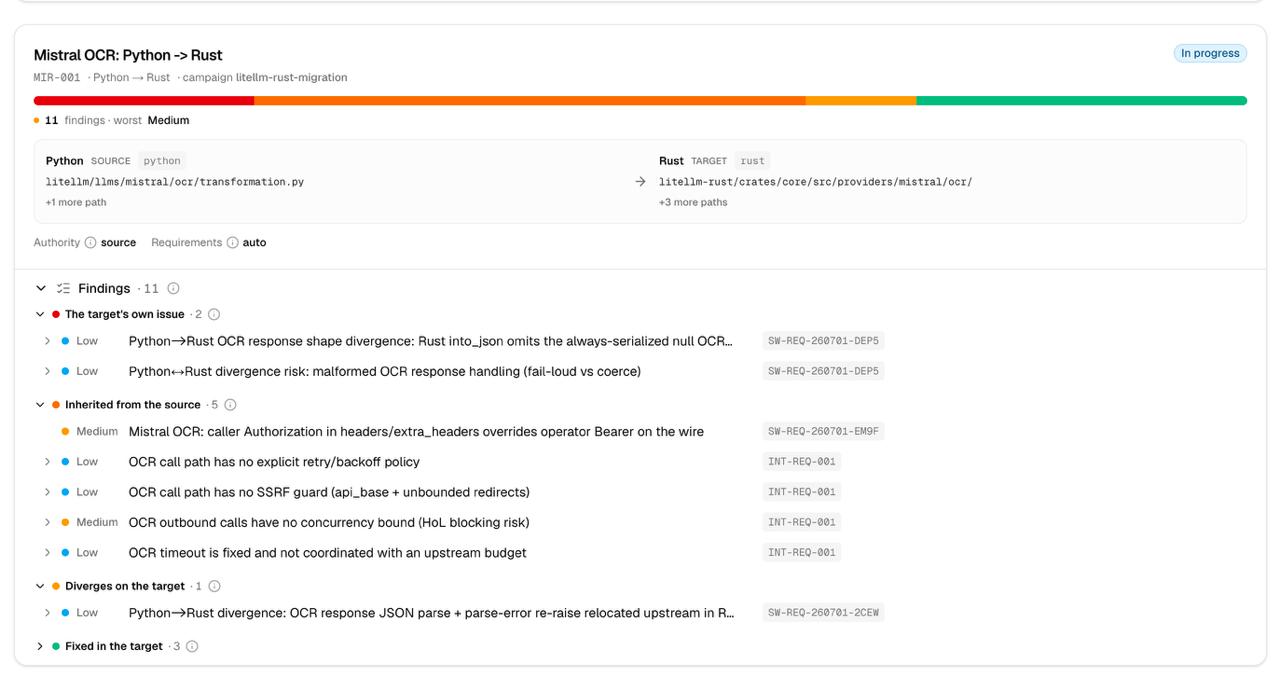
The mirrors view groups issues introduced by the replacement, inherited from the original, and fixed in the port. Each finding connects back to a requirement.
What must survive the rewrite?
Existing code shows what happens today. Your product owner, contracts and requirements determine which behavior to preserve and which to change.
Connect code, contracts, tests and earlier decisions. Bring undocumented rules and contradictory expectations to the person who can resolve them.
Record preserved behavior, intentional changes and open questions. Include errors, permissions, state changes and boundary cases, alongside successful responses.
Compare the implementations and check agreed requirements. Each material difference needs a disposition and evidence. Passing sampled inputs does not prove every possible behavior.
Retain the requirements, fixtures, results and decisions. Later changes can reuse that work and identify which evidence must be renewed.
Two ways to work together
Your engineers or delivery partner keep implementing. Proof works alongside them to recover requirements, investigate compatibility risks and produce evidence within the agreed scope.
Scope implementation and verification together. Start with a bounded API or service, an agreed target stack and an owner of the behavior it must preserve.
Scope, access, price and timing are agreed before work starts. Acceptance of a change and permission to cut over production remain separate decisions.
Before the first conversation
A short description is enough to start. Tell us the current and target stacks, what you cannot afford to break, and who owns the intended behavior. Do not send credentials or private source code through the form.